Parshat Bereishit 2025: Concealment, Illumination, and Conflict for the Sake of Connection
Rabbi Zvika Krieger, Chochmat HaLev
October 17, 2025
Two years ago, our celebration of Simchat Torah was marred by the news of the heinous Hamas attack on Israel on October 7 that claimed over 1000 lives, 250 kidnapped, and many thousands injured in the single deadliest day for Jews since the Holocaust.
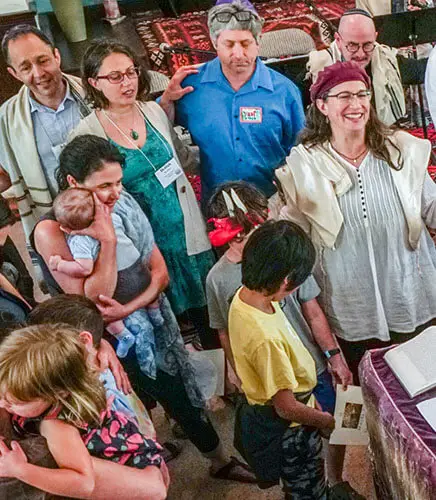
This week, in a synchronicity that would seem fictional if it were in the Torah, almost 300 of us gathered here on Simchat Torah, the same day two years later, to celebrate the end of this bloody chapter, which since October 7 has claimed the lives of tens of thousands of Palestinians, as well as hundreds of additional Israelis killed in Gaza. We celebrated the return of the hostages, the release of innocent prisoners, the ceasefire, and the return of humanitarian aid. We sang and danced our joy and our grief and our fear and all the feelings we’ve been holding for the past two years.
There are reasons to be hopeful. And there are reasons to be skeptical. We don’t know if the ceasefire will hold or if it will lead to a durable just peace. I’m hoping that we – this community – will keep our attention and our prayers on this fragile situation, and that we will continue fighting for justice, safety, and dignity for all in Israel-Palestine.
But with the return of the hostages and the ending of daily bloodshed and devastation, as Israelis and Palestinians begin to sort through the wreckage of the past two years, so must Jewish communities across the country that have been torn apart by this conflict.
In many ways, Chochmat HaLev has fared better than most. We managed to hold together a community with a wide range of perspectives on this conflict by committing to the spiritual practice of being in relationship with those who have differing beliefs. We committed to holding this conflict with nuance and complexity.
And yet, we were not immune to the strain of conflict in our midst. Across the political spectrum, many of us have felt under attack, and it can be hard to open up to people who feel like they are on the other side of the battlefield. I’ve spent hundreds of hours over the past two years in spiritual counseling sessions with many of you who are committed to this bridge-building work, yet understandably are finding it increasingly difficult in these polarizing times.
A significant amount of those conversations have revolved around people’s intense reactions to people wearing political symbols in a prayer space. I have not explicitly addressed this contentious topic from the bima (prayer podium) over the past two years. Many people tried to dissuade me from talking about it tonight. If I were smart, I probably wouldn’t be talking about this tonight. And if I’m being honest, I’m nervous. So I ask for your grace and compassion as I try my best.
This week seems like a good time to begin that conversation, both as tensions ease slightly amidst the ceasefire, but also because this week’s Torah portion talks about humans’ first experience with clothing, when כָּתְנוֹת עוֹר – garments of skin – were given to Adam and Eve. And I have this kryptonite: I stumble upon a poignant Torah teaching and I cannot not share it.
Bereishit Rabbah, a compilation of rabbinic wisdom from the 5th century, teaches that the great sage Rabbi Meir was actually in possession of another version of the Torah which included one letter different in this verse: Not Ohr spelled with the letter Ayin, which means skin, but Ohr spelled with the letter Alef, which means light.
These two versions offer two ways in which we relate to others: We can choose to put up barriers to connection, through garments of separation. Or we can choose to foster connection, through garments of illumination.
Over the past two years, we’ve all been forced to clarify our position on what has been happening in Israel and Gaza – perhaps sympathizing with one more than the other, or doggedly holding both equally. And for many of us, this position became more than just a political perspective, it became almost a tribe or an identity.
In every space we entered, and particularly in Jewish spaces, we learned to scan the crowd for hints about who was on our team – and who was on other teams. We wanted to know if we were safe and if we belonged. At a time of heightened tensions and rising violence in our own country, that is a reasonable impulse.
Some people have chosen to wear symbols. Yellow hostage ribbons, dog tags, keffiyehs, watermelon kippahs, Israeli and Palestinian flags – they all became signals. They proclaim where our sympathies primarily lie, they are an outward illustration of our values – for many of you, our Jewish values. I’ve heard from community members on all sides that these symbols are a way of expressing solidarity or standing up for what we believe in – often bravely and defiantly in spaces where those views are in the minority or not welcome. Many of you shared how you intended these symbols to disrupt conventional wisdom or shake others out of numbness or complacency.
Others in our community have a different want for their spiritual community: Rather than a space for political expression, they want their synagogue to be an oasis from the conflict that is sprawled on every street corner here in Berkeley. People want to pray in a place where they can be vulnerable, not on guard. Community members have expressed exasperation at having not consented to being the target of someone else’s activism. People want their sanctuary to be a literal sanctuary.
And for some, those signs of political expression have caused real harm. Many of us carry pain just beneath the surface – from personal violations, family histories of persecution, from the shock of October 7, from witnessing the suffering in Gaza, from rising antisemitism and other hatreds here at home. I’ve heard stories from many of you about the impact of walking into this sacred space and seeing someone wearing a symbol you associate with violence, loss, or betrayal. People have shared with me how their body tenses, their breath shortens, and suddenly they are no longer present in prayer but reliving danger. You’ve shared how seeing those symbols makes you feel negated or dismissed. When a symbol evokes pain or fear, it can make people feel unsafe in what they hoped would be a refuge.
The challenge with political symbols is they mean different things to different people. I don’t think anyone in our community intends to harm others. I’ve had the privilege to sit one-on-one with many of you who choose to wear these political symbols. I’ve been touched by the nuance and intentionality with which you choose to wear these symbols.
I wish everyone had both the time and the courage to approach someone wearing something that triggers them, to engage them in curious and civil conversation, understand their motives, share the way the symbol lands on them. I think both sides would be genuinely surprised and moved by those conversations – as we’ve seen in our dialogue groups. But the reality is that those conversations are few and far between – especially when new people enter our community and may decide to leave based on these first impressions, before the bridge-building can even begin.
This is the peril of political symbols. By their nature, it is hard for them to reflect the nuanced perspectives of the person who wears them. And based on my conversations over the past two years with hundreds of you on all sides of the issue, even if the wearer is intending to invite discussion, some of these symbols can prevent discussion. I don’t mean to dismiss all symbols – some can stoke generative disagreement and help create change. But I’ve heard from many in our community that some of these symbols harden hearts and reinforce polarization. I’m not saying this is a right or wrong reaction, I’m just sharing that it happens. A lot. They become Katnot Ohr with an Ayin, garments of concealment, rather than Ohr with an Alef, garments of illumination.
So what does that mean for our community? Early in the conflict, Chochmat leadership made a decision that any staff and anyone on the bima, anyone leading prayers or rituals, will be asked not to wear any political symbols, so as to not inadvertently signal that we took an institutional stand.
But when it comes to choices of our members and participants, I feel a genuine paradox: How do we help everyone in our community feel safe and comfortable when their needs appear mutually exclusive? For some people, safety means not encountering symbols they associate with threats to their existence. For others, safety means being able to bring their whole selves, including their political and ethical commitments. These two experiences do not align neatly with any of our ideological categories – pro-Israel, pro-Palestinian, Zionist, conditional Zionist, anti-Zionist, non-Zionist, or any amalgamation in between. Both perspectives on safety feel existential, not merely preferential.
I don’t want to police people’s clothing. I don’t want to say or do anything that silences legitimate debate or chills the diversity of perspectives in our community. But we also need to be honest that the status quo is alienating current members and potential members who feel uncomfortable and unwelcome.
It’s easy to say, “Well, if people can’t deal with being in community with people they disagree with, then Chochmat is not the right community for them.” And maybe part of me even agrees with that. But I’m encouraging us not to rest in that place. While our overall membership and attendance numbers are at historic highs, our ideological diversity – which is core to our spiritual practice – may be waning. If we take seriously the discomfort of those who feel marginalized by not wearing political symbols they find meaningful, we must equally take seriously the discomfort – and for some, the sense of threat – felt by those who associate certain symbols with calls for violence and destruction. Even if you feel that sense of threat is irrational or unreasonable, both are authentic experiences deserving of communal respect.
I don’t have any clear answers tonight. My intention is to bring this conversation from the shadows into the light of community, to grapple with these tensions together. If you think I’m personally attacking or criticizing you tonight, I hope you believe me when I say that is not my intention: I’m inviting you into conversation.
If you leave tonight thinking “Zvika said people should not wear kefiyahs or yellow hostage ribbons,” that is not what I said. If you leave tonight thinking “Zvika said it’s totally fine for people to wear kefiyahs and yellow hostage ribbons and Israeli flags and Palestinian flags,” that is also not what I said. I am inviting us into a conversation.
And the reality is that disagreements over clothing are symptoms of deeper disagreements about justice, identity, and what it means to be Jewish or Jew-adjacent in 2025. We’re committed to facilitating that deeper work. We’ll also continue to offer opportunities for connection and learning across differences, like the dialogue groups we’ve held over the past two years.
But as clothing and symbols are often the first thing people experience before they can even get to that work, I think it is worth each one of us considering what it means to be in a diverse community. “Everyone welcome” doesn’t always mean “everything goes.” Sometimes making everyone feel welcome means compromise for the sake of others. It’s worth considering what we’re hoping to accomplish, and if our decisions are actually helping to accomplish those goals, and if so, at what cost.
I’ll be honest that I am not an activist at heart. So I approach this topic with much humility. I’m not someone who wears political symbols, or signs petitions, or attends rallies. So I know I don’t fully understand the value of those forms of changemaking, and the diverse motivations for why people do them – and so I want to be careful not to come off as diminishing them. I’ve been grateful to learn from the many of you in our community who are passionate about these forms of change-making, and I look forward to continuing those discussions.
Let’s begin tonight with some heartfelt sharing on our Katnot Ohr – the ways in which we invite or close down exchange across difference. I invite you to turn to someone next to you, ideally someone you’ve never met before, and share your experiences on this topic. Are you someone who wears political symbols? Why or why not? What impact does it have on you when others do? How does it feel to see these outward expressions of ideological difference? What opens your heart to new perspectives, and what closes you off? What encourages you to approach someone with curiosity? How do you consider the impact of your decision on others? There is no right answer – just an invitation into open sharing and exploration together as a community.
***
In closing, let’s return to this week’s Torah portion. We read the Jewish creation myth, the story of how the God character created the world in seven days. Each day, God admires its creation, remarking, “Ki Tov – and it was good.” Except, there is one day in which the phrase is missing: Day Two, in which God creates the sky and the oceans. What could be “not good” about that?
Bereishit Rabbah, that same compilation of rabbinic wisdom from the 5th century, points out that unlike in the other days of creation, new things were not created on the second day; rather, it says VaYavdel (וַיַּבְדֵּל), God separated the primordial waters into הַמַּיִם אֲשֶׁר מִתַּחַת לָרָקִיעַ – the waters below the horizon, and הַמַּיִם אֲשֶׁר מֵעַל לָרָקִיעַ – the waters above the horizon.
So day two is not focused on creation, but division. Bereishit Rabbah goes so far as to say that מַחֲלוֹקוֹת, divisions, were created on Day Two. Of course not all divisions are bad: As taught by Rabbi Adina Allen, who will be speaking about her new book tonight after services, “Torah begins not with [the letter] Aleph – one, but with Beresheit, Bet, the numerical equivalent of two, Bet which is division, which is difference, which is the ever-unfolding multiplicity of life.” Rabbi Adina points out that the Tower of Babel, which we also read in the week’s Torah portion, is destroyed “to disrupt the uniformity of thought and speech” – sefah echat, in the Torah’s words – “and create a world of difference.” I would never want to be part of a community that tries to enforce that kind of uniformity.
But according to Bereishit Rabbah, the מַחֲלוֹקוֹת, the divisions created on Day Two are the source of conflict, strife, and polarization in our world. And this is why the God character did not dub this day as good, as “ki tov” – to charge us with making sure our conflicts are generative rather than destructive. I’m not here to tell you which category you fit into – I’m here to invite you into that self-reflection.
And as we embark on a new Jewish year and a new phase of the Israeli-Palestinian conflict, as we call in new beginnings with our Genesis Torah reading this week, let’s reflect on what it means to create a community together in which our divisions earn that “ki tov” – healthy, respectful, empathetic conflict for the greater good.
Mi Sheberach Avoteinu V’Imoteinu V’Horeinu, may the sacred Oneness that blessed our ancestors bless this community with the strength to hold many truths. Help us see one another not as sides of an argument, but as reflections of the same Divine light refracted through different waters. May we protect the multiplicity that gives our community life, and may our differences become the current that carries us closer to understanding. And may the work of our hearts this year be ki tov, bringing more goodness to our fractured world.
Rabbi Zvika Krieger is the spiritual leader of Chochmat HaLev. You can read more of his teachings here.